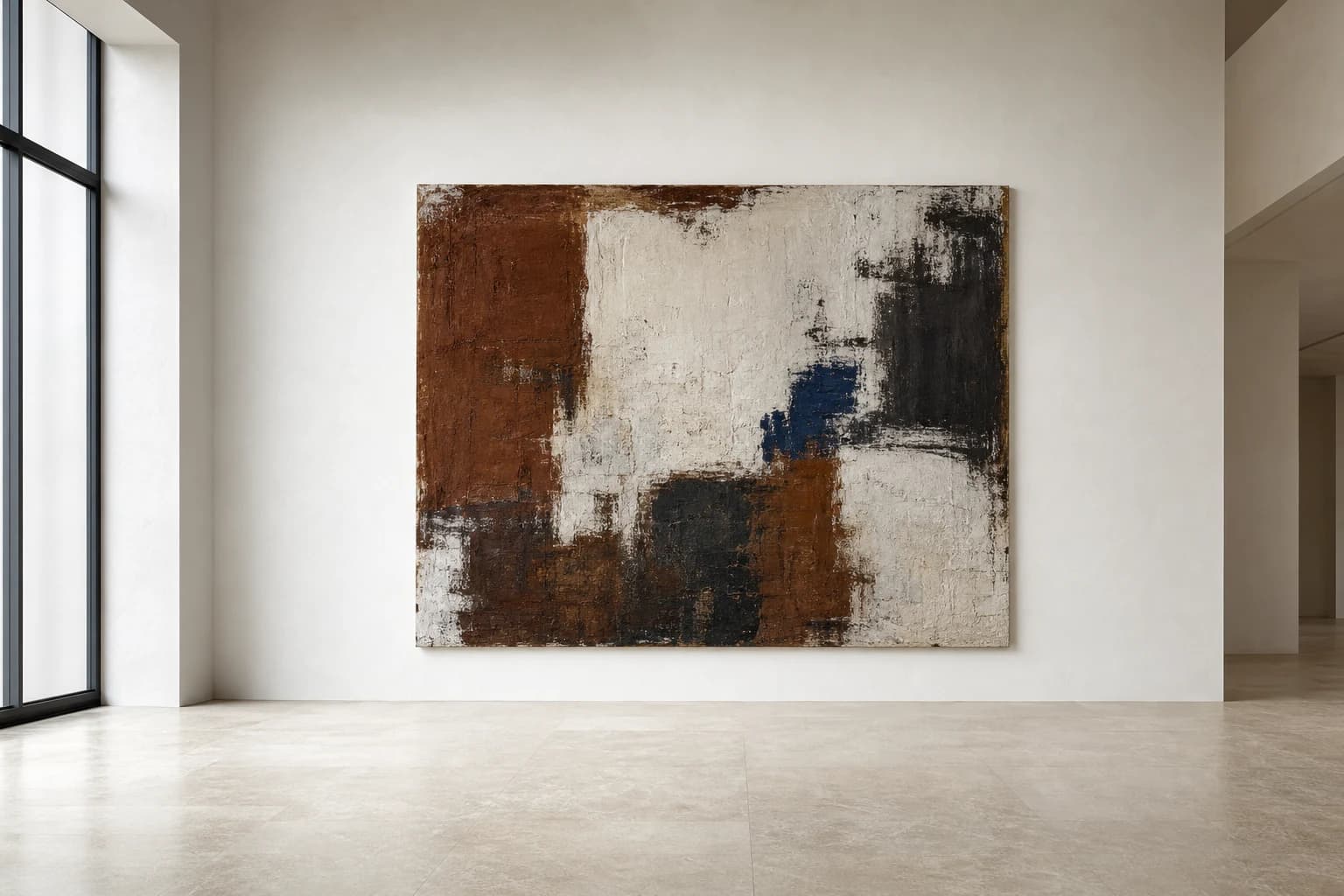
Two shifts are arriving together, and they point in the same direction. As machine-made images, text and sound become effortless and endless, genuinely made work grows rarer and more valued. And the way people find that work is moving away from a list of blue links toward a single, synthesised answer. An artist's own website sits precisely where those two shifts meet.
It is tempting to read the rise of AI as a threat to anyone who makes things by hand, over time, in the real world. The opposite is closer to the truth. When anything can be generated, the provenance of a thing—who made it, when, why, and what happened around it—becomes the scarce and valuable part. A website that holds that record clearly is not a marketing accessory. It is the evidence.
The real becomes the rare thing
For twenty years the online problem was abundance: too much content, too little attention. The new problem is authenticity. Audiences are learning to ask a quieter question behind every image—is this real, and can I trust where it came from?
Artists are unusually well placed to answer that question, because the work genuinely is real. It exists in studios, in exhibitions, in collections, in the specific history of a practice. The task is to make that reality legible online, so that a viewer arriving cold can tell, quickly, that they are looking at a real body of work with a real trajectory behind it—not a feed, and not a fabrication.
That is a presentation problem and a record-keeping problem at the same time. It is exactly the problem a considered website solves.
Search is quietly becoming answers
The second shift is more mechanical, and it is already underway. People increasingly begin with an assistant rather than a search box. They ask a question in plain language and receive a composed answer, often without visiting a single page. When someone asks an AI who a particular artist is, what they make, or where to see the work, a model assembles a reply from whatever it can find and trust.
This changes the stakes of being found. It is no longer only about ranking on a results page. It is about whether a machine can locate a clear, consistent, authoritative account of you—and whether it repeats that account correctly when someone asks.
If the most structured, current and trustworthy source about an artist is their own website, that is what gets summarised. If it is a half-updated profile on a platform, a decade-old interview, or nothing at all, that is what gets summarised instead.
What a model actually reads about you
An assistant does not admire your typography. It reads structure and facts: your name stated as text, a plain description of the practice, works with titles, dates, media and dimensions, an exhibition history with real venues and years, press with publications and authors, and clear representation and contact details. It rewards consistency—the same title spelled the same way everywhere—and it rewards recency.
None of this is exotic. It is the same discipline that helps a curator, a writer or a collector understand the work in ninety seconds. The encouraging part of this moment is that there is no separate "AI version" of a good website to build. The qualities that make you legible to a careful human being are, very nearly, the qualities that make you legible to a model: clarity, structure, accurate metadata, stable links and a record that is kept current.
The things that make you easy for a person to understand are the same things that make you easy for a machine to represent.
Own the account, or inherit someone else's
Here is the strategic point. Someone—or something—is going to produce a short account of who you are and what you make. The only real choice is whether it is assembled from a source you control and maintain, or stitched together from whatever fragments happen to exist.
A platform profile is borrowed ground. Its structure, its priorities and its longevity belong to the platform, not to you. Your own domain is the one place where the record is yours: complete, correctly credited, and answerable to no algorithm's redesign. In an environment where machines increasingly mediate first impressions, owning that authoritative source is not vanity. It is how you make sure the first thing anyone learns about you is true.
What this means in practice
The response is not to chase the technology. It is to do the durable things well, knowing they now pay off twice—once for the human visitor and once for the machine that reads on their behalf:
- State the essentials as real, selectable text, not baked into images.
- Give works consistent, complete information and keep captions uniform.
- Maintain an exhibition record with accurate status, so "current" is current.
- Keep press, publications and credits gathered and attributed.
- Use stable, human URLs, and replace files in place so old links survive.
- Above all, keep it current. A record that lags behind the practice misinforms people and machines alike.
This is ordinary stewardship. What is new is the size of its return.
Staying human on purpose
There is a temptation, in a moment obsessed with visibility, to optimise a practice into something a machine likes and a person forgets. That is the wrong lesson. The point of being found is to lead a real person to real work—an exhibition to visit, a studio to contact, a piece to stand in front of. The website is the reliable route to the real thing, not a replacement for it.
That is the balance worth holding. Let the record be clear enough that both people and machines can trust it, and let everything it points to be unmistakably, valuably human.
At Appesa, keeping that record accurate and current is the whole of the work—ongoing stewardship, not a launch and a farewell. The website should be ready for the important visitor who arrives tomorrow, and for the assistant that will answer on their behalf the day after.